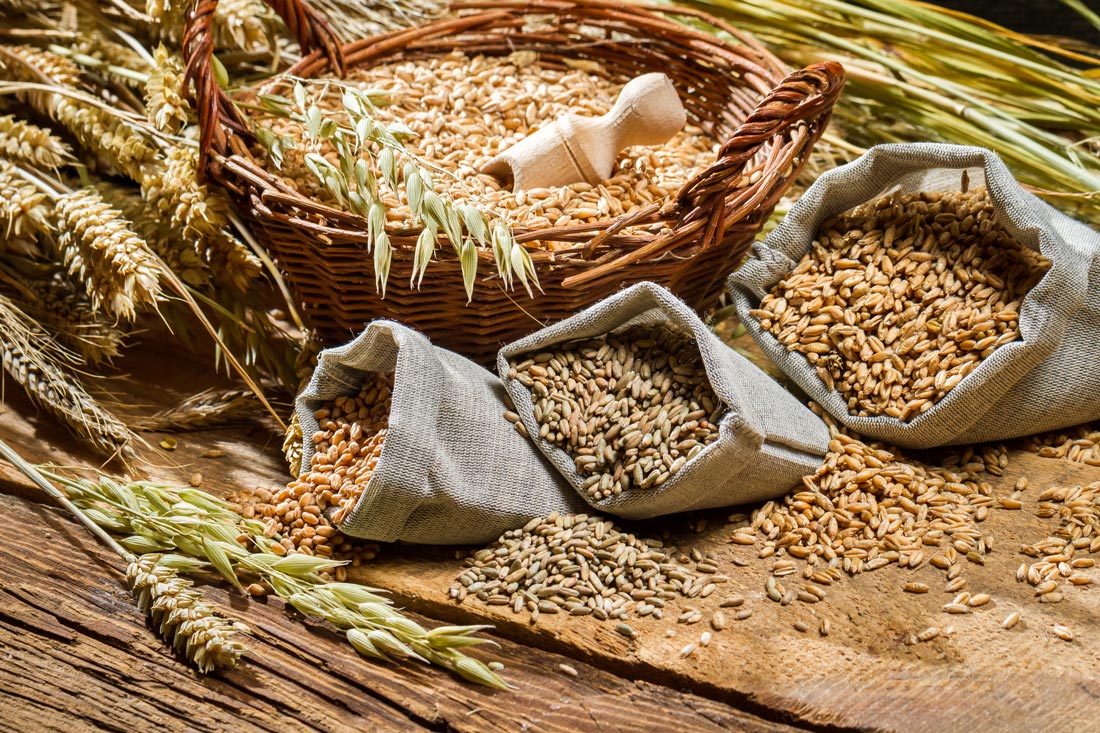
Below is a fairly comprehensive table of the main cereals. In particular, the following cereals are widespread in the Mediterranean basin: soft wheat, durum wheat, einkorn wheat, emmer wheat, spelt, maize, rice, oats, barley, and rye.
Oats – Once the staple food of Scotland and widely used as animal feed throughout the world.
Spelt (Farro) – Used since antiquity; it was one of the main cereals forming the basis of the diet in ancient Rome (see Wheat).
Fonio – Several varieties are cultivated in Africa.
Wheat – A group of distinct cereals (soft wheat, durum wheat, spelt, etc.) that constitute the main sources of energy in temperate climate regions. It is mainly cultivated in Emilia-Romagna and Puglia.
Buckwheat – Used in Europe and Asia. Important uses include pancakes and whole grains. It is not a true cereal, although it is often included in cereal lists.
Maize – One of the staple foods of populations in North America, South America, and Africa, as well as a major feed for livestock worldwide. It is commonly called corn or Indian corn in North America, Australia, and New Zealand. It is the cereal with the widest range of non-food uses (e.g. fabrics for clothing such as Ingeo, biodegradable cups and cutlery made from Mater-Bi, diapers, children’s toys, etc.).
Millet – A group of distinct cereals that represent an important source of nourishment in Asia and Africa.
Barley – Originally cultivated as animal feed in lands too poor or too cold for wheat. In addition to its use as fodder, it is used in beer production and has also spread as a hot beverage, often as a coffee substitute.
Quinoa – An ancient pseudocereal from the Andes.
Rice – The main cereal in tropical climate regions. It is also widely produced in Italy.
Rye – Important in cold climate areas.
Sorghum – An important food in Asia and Africa; used as animal feed worldwide.
Triticale – A hybrid of wheat and rye. It grows similarly to rye.